

According to reporting by ITV and Sky News, Alan Milburn said that “the evidence points in one direction” on a social media ban for under-16s. ITV says he was backing Lord Grade, the former Chair of Ofcom, who said yesterday* that his experience across the media industry has convinced him social media should be banned for under-16s.
Grade argued that, despite the Online Safety Act, too much harmful content remains online and he believes there is ‘nothing to lose’ from introducing a time-limited social media ban. For himself perhaps that is true, but it’s not the case for children or others using social media, worried about losing access to friends, information, or any any features and functionality under threat for all children up to 18. Or the age gating impact of a “children’s” ban for every adult too.
If one looks only at one side, of course the evidence points in one direction. But the evidence on a social media ban (“SMB” or the Australia Social Media Minimum Age restrictions “SMMA”) is not one-sided, nor about only one thing, and the full picture deserves wider reporting.
All of the responses I’ve seen and read so far, are here. This is only a one-sided selection of the publicly available submissions I have found so far, to demonstrate that the evidence is not all pointing in one direction as Milburn claims, the other way, in favour of a ban. A wide range of children’s rights bodies, safeguarding experts, educators, and online safety organisations have reached the opposite conclusion, against a ban. We recommend instead the evidence that recommends a features and functionality approach, while protecting identity and safeguarding children from AV too.
438 signatories signed a Joint Statement of security and privacy scientists and researchers on Age Assurance in Spring 2026, warning of the risks and unintended consequences of age verification and age gating online access.
Scotland’s Children’s Commissioner’s Office carried out a children’s rights impact assessment and concluded against a ban for under-16s.
The Commissioner for Children and Young People Northern Ireland believes, “it is the view of my office and I that over‑simplistic bans don’t protect children and can, in fact, make things worse by pushing them into more dangerous, unregulated online spaces where risks increase, not disappear.”
CRIN asks, what are we even talking about banning?
The Online Safety Network points out that a “ban” is often undefined and can mean a variety of approaches but offers no silver bullet to the issues.
The National Association of Head Teachers (NAHT) is concerned that the discourse has become reductive and overly simplified around the binary choice of banning social media for under-16s. It warns that a ban could limit access to positive online support for vulnerable children.
The Association of School and College Leaders (ASCL) cautions against the misapprehension that a blanket ban for under-16s will “solve the problem,” and warns that such a ban introduces harm through a “cliff edge” effect, as does the coalition at the Back Youth Alliance. ASCL is among those who note that in Australia, the ban is not protecting young people as intended.
UNICEF has welcomed the growing commitment to children’s online safety but cautioned that social media bans carry their own risks, “and may even backfire”.
South West Grid For Learning says they, “do not believe a blanket social media ban is the solution.”
The Molly Rose Foundation argues that blanket bans would fail to deliver the improvement in children’s safety and wellbeing that is so urgently needed, calling it a blunt response that fails to address the successive shortcomings of tech companies. The Foundation also conducted polling on whether Australia’s social media ban is working (2026). It found that most children do not feel the ban has improved how safe they feel online, and that 1 in 8 felt less safe.
Public First polling found in the UK that while nearly two-thirds asked support a blanket ban on under-16s using social media, 68% say it would not work, and 50% of parents would still allow access to social media even if a ban were in place. [Collection date: 19 – 22 Jan 2026 | Sample size n=2,045].
Girlguiding’s March 2026 research found that just over half (56%) of those asked think a ban would be ineffective, as under-16s would still find a way onto social platforms. When asked, 47% of 10-16 year olds said they believed social media posed risks, but only 15% said they thought a ban would make them feel safer online.
The Foundation for Information Policy Research (FIPR, Cambridge) argues that age restrictions and technical solutions alone will not resolve, and may worsen, the central problems they are meant to tackle.
The multi-organisational Gamer’s Voice issued a joint statement opposing the placing of internet services, including games, behind an age-gate. Their position is that UK policymakers must prioritise addressing the roots of online harm rather than undermining the open web.
NYA opposes a ban, noting that as the voting age moves to 16, a ban on social media would also hinder their readiness to participate meaningfully in democratic processes.
In Australia, researchers showed that in those who lost access when the ban does “work”, news access and civic engagement plummets: one in two of those significantly impacted by the ban say they are now getting less news (Notley et al., 2026).
Internet Matters does not support a blanket legal ban on children’s access to social media. It warns that a blanket ban could cut children off from spaces they use for learning, creativity, connection and support, while missing similar risks on other services.
My own research at Defend Digital Me finds that the age-gating technology adopted across a wide range of companies to meet Australia’s social media ban obligations has lifelong implications for children’s privacy, biometric and data protection rights, meaning children have no control over their data for life. Implications the UK government appears to have not yet considered or risk assessed. And not only for children but for everyone, obliged to use age verification technology to prove that they are not a child.
Jim Gamble, QPM, CEO of the INEQE Safeguarding Group (which incorporates Safer Schools), advocates for sensible restrictions rather than outright bans.
The NSPCC suggests three key, urgent changes that are needed to protect children online – changes that go far beyond [and better than] what a simple social media ban could achieve.
The Open Rights Group encourages the Government not just to ban and restrict children, but to build better online spaces for young people, and predicts that bans and age-gating measures will ultimately prove ineffective.
The UN human rights office summarises the view of the majority of UK and wider experts, blocking children from social media is no substitute for making platforms safe in the first place.
At the end of the day, the weight of considered expert evidence right now from those working directly on children’s safety, education, and digital rights does not support a blanket ban. It points instead toward addressing the underlying causes of online harm, building better online spaces, and holding tech companies to account.
Information Labs summarises some of that from across the EU and beyond.
Politicians that appear too weak to regulate platforms’ business models, are punishing children for something they didn’t create.
At a time when many countries are reviewing their legislation on children’s access to social media, recent discussion at organised by the Steering Committee for the Rights of the Child (CDENF), in co-operation with the Steering Committee for Human Rights in the fields of Biomedicine and Health (CDBIO), under the auspices of the Presidency of Monaco of the Council of Europe Committee of Ministers, sought to identify ways to best balance the protection of children with the respect for their rights and their participation. National government speakers were the outliers on claiming they know best for children calling to impose social media bans. Every rights’ based organisation opposes it. Quality evidence does too.
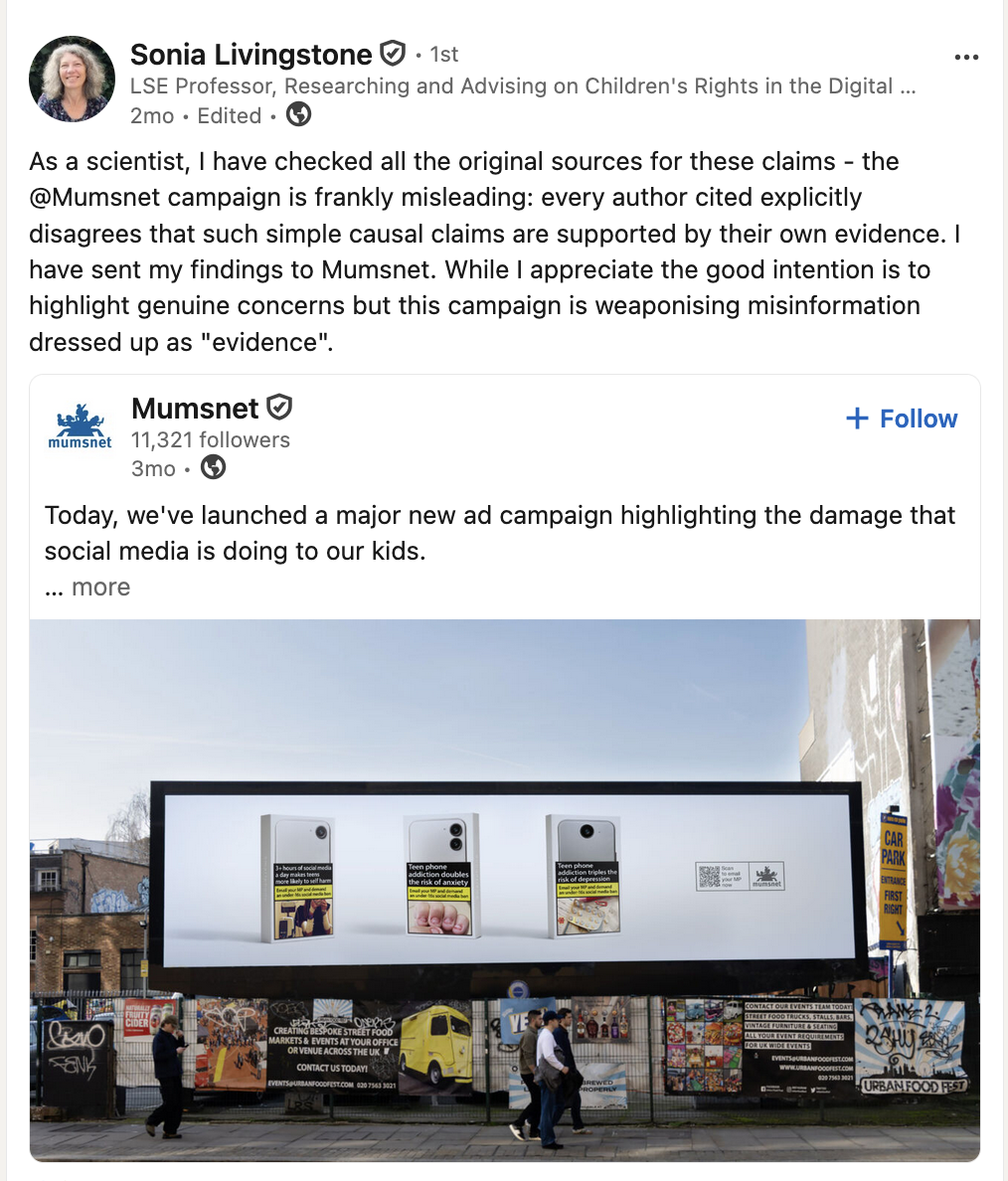
Claiming the evidence points in one direction only works if you decline to look at the rest. And worse, some of the “evidence” is pure misinformation.
*updated on June 11th to add more available links to UK consultation submissions, and the event organised by the CoE Steering Committee for the Rights of the Child (CDENF).